

Academic research is a systematic process of studying a topic, problem, or question using evidence, logic, and accepted research methods. You usually encounter academic research when writing a thesis, dissertation, research paper, or journal article.
However, academic research is not just searching information from books, websites, or reports. It requires a clear research problem, relevant literature, appropriate methods, credible evidence, careful analysis, and logical interpretation.
This article explains the meaning, purpose, key features, types, examples, and basic steps of academic research.

Key Takeaways
- Academic research is a systematic and evidence-based process used to answer research questions, solve problems, test ideas, or contribute to knowledge.
- You can conduct stronger academic research by starting with a clear research problem, choosing an appropriate method, and presenting findings based on evidence.
- (Read more for comprehensive understanding.)
What Is Academic Research?
Academic research is a structured investigation carried out to understand a topic, examine a problem, answer a question, test a theory, or generate new knowledge.
In simple words, academic research means studying something carefully using established scientific methods. Academic research is also known as scientific research.
It is different from ordinary reading or information searching. For example, if you read several websites about unemployment and write a summary, that is only information collection. But if you ask a clear research question, review previous studies, collect or analyze data, and present evidence-based findings, that becomes academic research or scientific research.
General topic: Youth unemployment
Academic research topic: Factors influencing youth unemployment among university graduates in Nepal.
The second one is more researchable because it identifies a specific issue, purpose, and study context.
Definition of Academic Research
Academic research can be defined as a systematic, evidence-based, and logical investigation conducted to answer research questions, solve problems, test ideas, or contribute to knowledge in a particular field.
This definition highlights four important ideas.
- First, academic research is systematic because it follows planned steps.
- Second, it is evidence-based because it uses data, documents, observations, scholarly sources, or other credible materials.
- Third, it is logical because arguments and conclusions must be connected to evidence.
- Fourth, it contributes to knowledge by improving understanding of a topic, problem, or issue.
Purpose of Academic Research
The main purpose of academic research is to produce reliable knowledge. It helps researchers understand problems, examine relationships, test assumptions or hypothesis, and conclude with evidence.
Academic research may be conducted to:
- Understand a problem more clearly
- Answer specific research questions
- Test theories or hypotheses
- Explore people’s experiences or behavior
- Measure relationships between variables
- Evaluate policies, programs, or interventions
- Develop new concepts, models, or explanations
- Identify gaps in existing knowledge
- Support decision-making with evidence
For you as a researcher, academic research also develops important skills such as critical thinking, academic writing, data collection, data analysis, and logical argumentation.
Key Features of Academic Research
Academic research has several important features that distinguish it from ordinary opinion or casual information search.
1. Academic Research Is Systematic
Academic research follows an organized process. You do not randomly collect information. Instead, your study usually moves through steps such as selecting a topic, identifying a research problem, reviewing literature, choosing a method, collecting data, analyzing findings, and writing conclusions.
A systematic process helps make your research clear, transparent, and credible.
2. Academic Research Is Based on Evidence
Academic research must be supported by evidence. Evidence comes from results of data analysis and data may come from surveys, interviews, experiments, observations, official records, previous studies, statistical datasets, or documents.
A claim without evidence is only an opinion. Academic research requires evidence to support its arguments.
Example:
Opinion: Online learning is not effective.
Research-based statement: Survey results from 300 university students showed that poor internet access, limited interaction, and lack of self-discipline were major challenges in online learning.
The second statement is stronger because it is based on evidence.
3. Academic Research Has a Clear Research Problem
A good academic study begins with a clear research problem. The research problem explains what issue your study will investigate and why it matters.
A broad topic might not be enough or sometimes a broad topic becomes unfeasible for research.
Example:
Too broad: Education in Nepal
Better research problem: Why do students from rural areas have lower completion rates in higher education?
The second example is clearer because it focuses on a specific issue.
4. Academic Research Uses Appropriate Methods
Academic research uses methods that match the research question. You may use quantitative methods, qualitative methods, mixed methods, experiments, surveys, interviews, case studies, document analysis, or secondary data analysis.
The method should not be selected randomly. It should fit the purpose of your study.
5. Academic Research Is Analytical
Academic research does not only describe information. It analyzes, compares, explains, evaluates, or interprets evidence.
6. Academic Research Is Transparent
A good academic study clearly explains how it was conducted. Your reader should understand your research design, sample, data collection method, data analysis technique, and limitations.
Transparency helps your reader judge whether your findings are credible.
7. Academic Research Follows Ethical Principles
Academic research should be conducted honestly and responsibly. Ethical research respects participants, protects privacy, avoids plagiarism, uses proper citation, and reports findings truthfully.
Research ethics is especially important when your study involves human participants, sensitive information, personal data, or vulnerable groups.
Academic Research vs Ordinary Information Search
The difference between ordinary information search and academic research is presented in the table below:
| Ordinary Information Search | Academic Research |
|---|---|
| Collects general information | Answers a specific research question |
| May use random sources | Uses credible and relevant sources |
| Often descriptive | Analytical and evidence-based |
| Does not always follow a method | Requires a clear methodology |
| May be opinion-based | Must be supported by evidence |
| Usually has no research gap | Addresses a problem or gap |
| May not produce new understanding | Aims to contribute to knowledge |
Types of Academic Research
Basic Research
Basic research aims to develop knowledge or theory. It may not have an immediate practical application.
Example:
A study on motivational bases of public sector employees.
Applied Research
Applied research focuses on solving a practical problem.
Example:
A study on how digital payment systems affect tax compliance among small businesses.
Quantitative Research
Quantitative research uses numerical data and statistical analysis. It is often used to measure relationships, test hypotheses, and generalize findings from a sample to a population.
Example:
A survey measuring the relationship between job satisfaction and employee performance.
Qualitative Research
Qualitative research uses non-numerical data such as interviews, observations, documents, and narratives. It is useful for understanding meanings, experiences, perceptions, and social processes.
Example:
An interview-based study on the experiences of new immigrants in USA.
Mixed Methods Research
Mixed methods research combines quantitative and qualitative approaches in one study. It is useful when one method alone is not enough to answer the research question.
Example:
A study that first surveys students about online learning and then interviews selected students to understand their experiences in depth.
Descriptive Research
Descriptive research explains the characteristics of a population, situation, or phenomenon.
Example:
A study describing internet access among students in rural municipalities.
Explanatory Research
Explanatory research examines why or how something happens.
Example:
A study explaining why some local governments implement public policies more effectively than others.
Exploratory Research
Exploratory research investigates a topic that is new, unclear, or not well understood.
Example:
A study exploring how artificial intelligence tools are used by university students for academic writing.
Examples of Academic Research Topics
Academic research can be conducted in many fields.
Education
- Factors influencing students’ academic performance
- The effect of online learning on student engagement
- Challenges faced by teachers in using digital tools
Economics
- The effect of remittance on household consumption
- The impact of inflation on low-income households
- Factors influencing youth unemployment
Public Administration
- The effect of public service motivation on job performance
- Factors influencing citizen satisfaction with local government services
- The role of e-governance in improving service delivery
Health
- Factors influencing vaccination behavior
- The effect of health awareness on preventive care
- Challenges faced by rural communities in accessing health services
Management
- The effect of leadership style on employee motivation
- The relationship between organizational culture and performance
- The influence of job satisfaction on employee turnover intention
Basic Steps in Academic Research
Academic research usually follows a logical process. The exact steps may differ by discipline, but the general flow is similar.
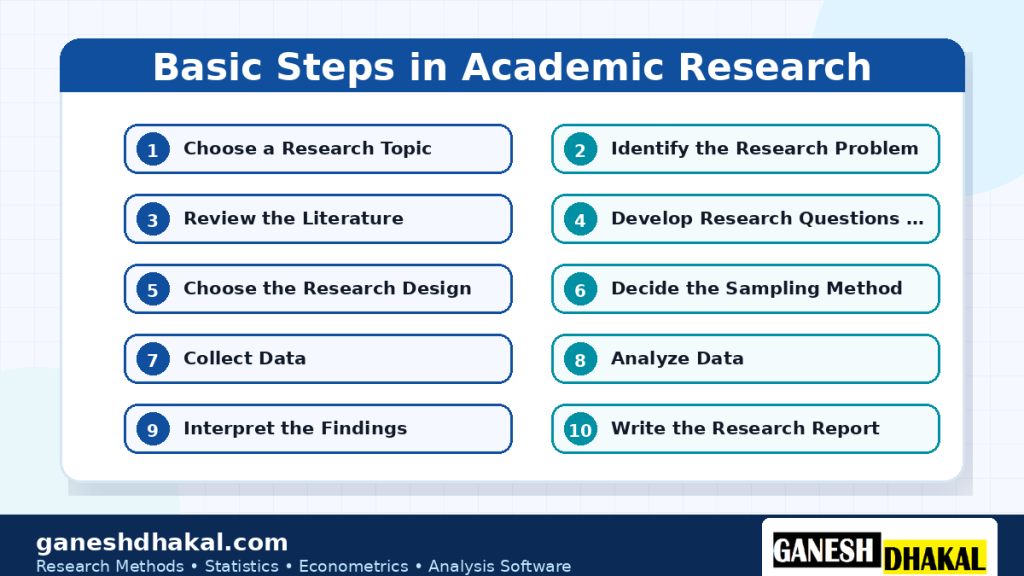
Step 1: Choose a Research Topic
Your topic should be relevant to the society, feasible, and connected to your field of study.
Public service motivation among civil servants.
Step 2: Identify the Research Problem
The research problem explains the specific issue your study will investigate.
Although public service motivation has been widely studied, limited evidence exists on how it affects job performance in non-western context.
Step 3: Review the Literature
A literature review helps you understand previous studies, theories, methods, findings, and gaps.
It helps you answer these questions:
- What is already known?
- What is still unclear?
- What gap does my study address?
Step 4: Develop Research Questions or Hypotheses
Research questions guide the study.
Example:
How does public service motivation affect job performance?
A hypothesis is a testable statement.
Example:
Public service motivation has a positive relationship with job performance.
Step 5: Choose the Research Methodology
The research methodology is the overall plan of the study.
To understand this part more clearly, read: What Is Research Methodology? Meaning, Types, and Examples.
Step 6: Decide the Sampling Method
Sampling explains who or what will be included in the study.
Example:
Civil servants working in selected federal offices.
Your sampling method should fit your population, research design, and available resources.
Step 7: Collect Data
Data may be collected through questionnaires, interviews, observations, experiments, documents, or secondary datasets.
Your data collection method should provide the kind of evidence needed to answer your research question.
Step 8: Analyze Data
Data analysis depends on the type of data and research question.
Quantitative studies may use statistics, regression, factor analysis, or econometric models.
Qualitative studies may use thematic analysis, content analysis, or narrative analysis.
Step 9: Interpret the Findings
Interpretation explains what the results mean in relation to the research questions, theory, previous studies, and context.
You should avoid making claims that go beyond your evidence.
Step 10: Writing Thesis or Research Report
The final research report usually includes introduction, literature review, methodology, results, discussion, conclusion, and references.
Your writing should clearly explain what you studied, why you studied it, how you studied it, what you found, and what the findings mean.
What Makes Academic Research Good?
Good academic research should be clear, logical, ethical, and evidence-based.
A strong academic study usually has:
- A clear research problem
- A focused research question
- Relevant literature review
- Appropriate research design
- Suitable sampling method
- Reliable data collection process
- Proper data analysis method
- Honest interpretation of findings
- Clear explanation of limitations
- Proper citation and referencing
A good study does not need to be unnecessarily complicated. Even a simple study can be strong if the research question is clear, the method is appropriate, and the evidence is carefully analyzed.
Common Mistakes in Academic Research
Beginners often make several common mistakes. If you avoid these mistakes, your research will become clearer and more credible.
Choosing a Topic That Is Too Broad
If you choose a very broad topic, your study may become unfocused.
Too broad: Poverty in the Philippines
Better: How does remittance affect household education spending in the Philippines?
Writing Unclear Research Questions
If your research question is unclear, your methodology and analysis may also become unclear.
A good research question should be specific, researchable, and connected to your research problem.
Ignoring the Literature Review
If you ignore the literature review, you may repeat what has already been studied or miss important theories and findings.
A literature review helps you identify gaps and justify your study.
Using a Weak or Unsuitable Methodology
If your methodology does not match your research question, your findings may not be convincing.
Example:
If you want to measure the relationship between two variables, you usually need quantitative data. If you want to understand personal experiences, qualitative interviews may be more suitable.
Making Claims Not Supported by Evidence
Your conclusion should be based on your evidence. Do not make claims that your data cannot support.
If your study is based on a small sample from one institution, you should be careful about generalizing the findings to the whole country.
Avoiding these mistakes can greatly improve the quality of academic research.
Why Academic Research Matters
Academic research matters because it helps society understand problems, evaluate solutions, and make better decisions. It supports scientific development, policy improvement, institutional reform, professional practice, and public debate.
For you as a researcher, academic research is also important because it develops independent thinking. It teaches you how to ask meaningful questions, evaluate evidence, use proper methods, and communicate findings clearly.
Academic research is not only about completing a thesis or assignment. It is a way of thinking carefully, questioning assumptions, and building knowledge through evidence.
Frequently Asked Questions
Is academic research the same as thesis writing?
No. Thesis writing is one form of academic research. Academic research can also appear as journal articles, conference papers, research reports, policy papers, dissertations, and working papers.
Does academic research always require data?
Most academic research requires some form of evidence. This may include primary data, secondary data, documents, literature, observations, or theoretical arguments.
Can academic research be qualitative?
Yes. Academic research can be quantitative, qualitative, or mixed methods. Qualitative research is common in education, sociology, public administration, management, health, and many other fields.
What is the most important part of academic research?
A clear research problem is one of the most important parts of academic research. Without a clear problem, the research question, literature review, methodology, and analysis may become weak.
Is academic research difficult?
Academic research can be challenging, but it becomes manageable when followed step by step. A clear topic, good research question, appropriate method, and careful writing make the process easier.
Conclusion
Academic research is a systematic and evidence-based process of studying a topic, problem, or question. It helps you generate knowledge, test ideas, solve problems, and support decisions with evidence.
If you are beginning academic research, start with a clear research problem. Then review the literature, develop research questions, choose an appropriate method, collect or analyze evidence, and present your findings honestly. A good academic study is not necessarily complicated; it is clear, logical, ethical, and supported by evidence.