Research methodology is one of the most important parts of academic research. It explains how you plan to conduct your study and how you will produce reliable evidence to answer your research question.
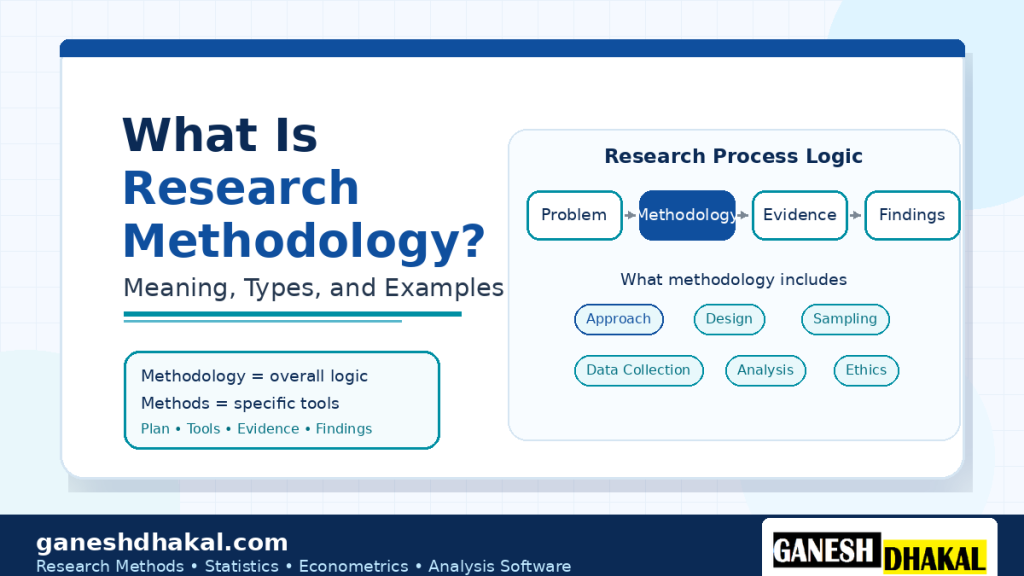
Research methodology and research methods are related, but they are not exactly the same. Research methods are the specific tools or techniques you use to collect and analyze data, while research methodology is the overall logic, plan, and justification behind those methods.
When you write a thesis, proposal, or research article, your methodology tells the reader how your study is designed, why your chosen approach is appropriate, and how your evidence will support your findings.
Key Takeaways
- Research methodology means the overall plan and reasoning that guides how you conduct a study.
- It matters because it helps you justify your research design, data collection, sampling, analysis, and interpretation.
- You can write a stronger methodology by clearly connecting your research question, research design, methods, data, and analysis.
What Is Research Methodology?
Research methodology refers to the systematic plan and reasoning used to conduct a research study. It explains how you move from a research problem to evidence, analysis, findings, and conclusions.
In simple words, research methodology answers this question:
How will you conduct your research, and why is this the right way to do it?
For example, if you are studying public service motivation among civil servants, your methodology may explain that you are using a quantitative survey design, collecting questionnaire data from selected public employees, and analyzing the data using statistical techniques.
The methodology does not only say what you will do. It also explains why your chosen approach is suitable for your research question.
If you are new to academic research, you may first read What Is Academic Research? Meaning, Purpose, and Examples.
Note: Research methodology and research methods are closely connected, but they are different. To understand it in detail, you may read Research Methods vs Research Methodology: Key Differences
Why Research Methodology Matters
Research methodology matters because it shows whether your study is logically planned and academically credible.
A good methodology helps the reader understand how your research question will be answered. It also shows that your findings are not based on personal opinion, guesswork, or random information.
In academic research, it is not enough to say what you found. You must also show how you found it. This is why methodology is important.
A clear methodology helps you:
- Choose a suitable research design
- Identify the right data source
- Select an appropriate sample
- Use suitable data collection tools
- Apply proper analysis techniques
- Explain the limitations of your study
- Make your findings more credible
Main Components of Research Methodology
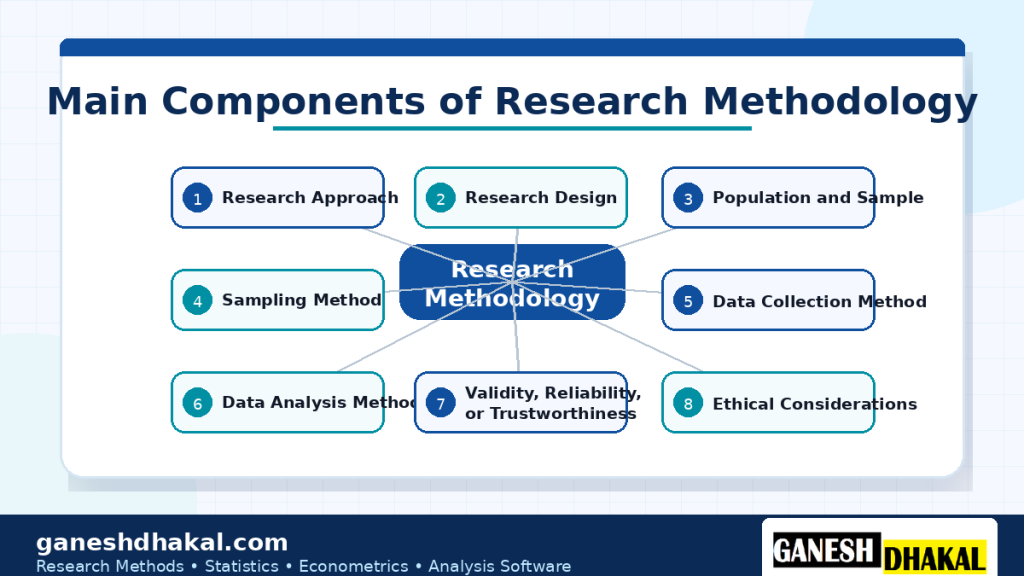
A research methodology usually includes several connected parts. The exact structure may differ by university, discipline, or journal, but most methodology sections include the following components.
Research Approach
The research approach explains the general direction of your study. It may be quantitative, qualitative, or mixed methods.
A quantitative approach uses numerical data and statistical analysis. A qualitative approach uses non-numerical data such as interviews, observations, documents, or narratives. A mixed methods approach combines both quantitative and qualitative evidence.
Research Design
Research design is the overall structure of the study. It explains how the research will be organized to answer the research question.
Common research designs include descriptive, exploratory, explanatory, correlational, experimental, case study, and comparative designs.
For example, if you want to describe the level of citizen satisfaction with local government services, you may use a descriptive design. If you want to examine whether service quality affects citizen satisfaction, you may use an explanatory or correlational design.
Population and Sample
The population is the full group you want to study. The sample is the smaller group selected from that population.
For example, if your study is about civil servants in USA, all civil servants may be your population. If you collect data from selected federal offices, those respondents are your sample.
Your methodology should explain who is included, why they are included, and how they are selected.
Sampling Method
Sampling method explains how you choose participants, cases, documents, or observations for your study.
Common sampling methods include random sampling, stratified sampling, purposive sampling, convenience sampling, and snowball sampling.
The sampling method should match your research design and research purpose.
Data Collection Method
Data collection method explains how you will gather evidence.
You may collect data through questionnaires, interviews, focus group discussions, observations, experiments, official records, documents, or secondary datasets.
For example, if you are studying employee motivation, you may use a structured questionnaire. If you are studying the experience of rural health workers, you may use interviews.
Data Analysis Method
Data analysis method explains how you will examine and interpret the collected data.
Quantitative studies may use descriptive statistics, correlation, regression, factor analysis, or econometric models. Qualitative studies may use thematic analysis, content analysis, narrative analysis, or case analysis.
Your analysis method should directly connect with your research questions.
Validity, Reliability, or Trustworthiness
A good methodology also explains how the quality of the research will be maintained.
In quantitative research, you may discuss validity and reliability. In qualitative research, you may discuss credibility, transferability, dependability, and confirmability.
This section helps readers judge whether your research process is careful and trustworthy.
Ethical Considerations
Ethical considerations explain how you protect participants and conduct the research responsibly.
This may include informed consent, confidentiality, voluntary participation, data protection, and avoidance of harm.
Even if your study does not involve sensitive data, it is still good practice to explain how ethical issues are handled.
Types of Research Methodology
There are different types of research methodology. The main types are quantitative, qualitative, and mixed methods.
Quantitative Research Methodology
Quantitative methodology is used when your study deals with numbers, measurement, and statistical analysis.
You may use this methodology when you want to measure variables, test hypotheses, examine relationships, compare groups, or analyze patterns using numerical data.
Example:
A study examining the relationship between public service motivation and job performance among civil servants may use quantitative methodology. The researcher may collect survey data using a questionnaire and analyze the relationship using correlation or regression.
Quantitative methodology is useful when you want structured measurement and generalizable findings.
Qualitative Research Methodology
Qualitative methodology is used when your study focuses on meanings, experiences, perceptions, processes, or social contexts.
You may use this methodology when you want to understand how people think, feel, behave, or interpret a situation.
Example:
A study exploring the challenges faced by teachers in using digital learning tools may use qualitative methodology. The researcher may conduct interviews and analyze themes from the responses.
Qualitative methodology is useful when you need depth, context, and detailed explanation.
Mixed Methods Research Methodology
Mixed methods methodology combines quantitative and qualitative approaches in one study.
You may use this methodology when numbers alone are not enough, or when qualitative explanations can help you understand quantitative results more deeply.
Example:
A study on citizen satisfaction with local government services may first use a survey to measure satisfaction levels and then conduct interviews to understand why citizens are satisfied or dissatisfied.
Mixed methods methodology is useful when your research problem requires both measurement and explanation.
Examples of Research Methodology
Here are some examples of how methodology may look in different fields.
| Field | Research Topic | Possible Methodology |
|---|---|---|
| Education | Online learning and student engagement | Quantitative methodology |
| Economics | Remittance and household consumption | Quantitative methodology using secondary data |
| Public Administration | Public service motivation and job performance | Quantitative methodology |
| Health | Barriers to vaccination in rural communities | Qualitative interview methodology |
| Management | Leadership style and employee motivation | Quantitative or mixed methods methodology |
| Local Governance | Citizen satisfaction with municipal services | Mixed methods methodology |
These examples show that methodology depends on the research question. You should not choose a methodology only because it is popular. You should choose it because it fits your study.
How to Choose the Right Research Methodology
To choose the right research methodology, start with your research question.
Ask yourself:
- What do I want to find out?
- Do I need numerical measurement or detailed explanation?
- Am I testing a relationship, describing a situation, exploring an experience, or explaining a process?
- What kind of data do I need?
- Who or what will provide the evidence?
- How will I analyze the evidence?
If your question asks “how many,” “how much,” “what is the relationship,” or “what is the effect,” a quantitative methodology may be suitable.
If your question asks “how,” “why,” “what does it mean,” or “what are the experiences,” a qualitative methodology may be suitable.
If your question requires both measurement and deeper explanation, mixed methods may be suitable.
Example
Suppose your topic is employee motivation in public organizations.
If your question is “What is the relationship between public service motivation and job performance?” you may use quantitative methodology.
If your question is “How do civil servants experience motivation in their daily work?” you may use qualitative methodology.
If your question is “What factors influence motivation, and how do employees explain those factors?” you may use mixed methods methodology.
Common Mistakes in Research Methodology
Many students make mistakes in the methodology section because they describe methods without explaining the logic behind them.
One common mistake is choosing a methodology without connecting it to the research question. For example, using a survey may not be suitable if your real aim is to understand deep personal experiences.
Another mistake is writing only a list of tools. A methodology section should not simply say “questionnaire, sampling, SPSS, and regression.” It should explain why these choices are appropriate.
Some students also confuse research design with data collection method. A survey is a data collection method, but the broader design may be descriptive, correlational, or explanatory.
Another common mistake is copying a methodology from another thesis. Your methodology must fit your own research problem, population, data, and purpose.
You should also avoid making the methodology too vague. Statements such as “this study used scientific methods” or “data were analyzed properly” do not tell the reader enough.
How to Write Research Methodology in a Thesis or Proposal
When you write methodology in a thesis or proposal, organize it clearly.
You can use the following structure:
- Research approach
- Research design
- Population and sample
- Sampling method
- Data collection method
- Measurement or instruments
- Data analysis method
- Validity, reliability, or trustworthiness
- Ethical considerations
- Limitations of the methodology
You do not need to make the section unnecessarily complicated. The goal is to make your research process clear, logical, and defensible.
A simple writing pattern is:
This study uses a [quantitative/qualitative/mixed methods] approach because the research aims to [explain your purpose]. The study adopts a [research design] design. Data will be collected from [population/sample] using [data collection method]. The collected data will be analyzed using [analysis method] to answer the research questions.
Research Methodology Checklist
Before finalizing your methodology section, check the following:
- Does your methodology match your research question?
- Have you clearly explained your research approach?
- Have you identified your research design?
- Have you described your population and sample?
- Have you justified your sampling method?
- Have you explained your data collection method?
- Have you explained your data analysis method?
- Have you addressed validity, reliability, or trustworthiness?
- Have you included ethical considerations?
- Have you avoided copying another study’s methodology without adapting it?
Frequently Asked Questions
Is research methodology the same as research methods?
No. Research methodology is the overall plan and reasoning of the study. Research methods are the specific tools or techniques used for data collection and analysis.
What is the main purpose of research methodology?
The main purpose of research methodology is to explain how the study will be conducted and why the chosen approach is appropriate for answering the research question.
What are the main types of research methodology?
The main types are quantitative methodology, qualitative methodology, and mixed methods methodology.
Can one study use more than one methodology?
Yes. A mixed methods study uses both quantitative and qualitative approaches. However, you should clearly explain why both are needed.
How long should a methodology section be?
The length depends on the level of study and institutional requirements. A thesis methodology chapter is usually longer than a journal article methodology section.
What should I avoid in research methodology?
You should avoid vague explanations, copied methodology, methods that do not match your research question, and listing tools without justification.
Conclusion
Research methodology is the overall plan and logic that guides your academic research. It explains how you will conduct the study, collect evidence, analyze data, and justify your findings.
A strong methodology is not just a technical requirement. It helps readers trust your research because it shows that your study is planned carefully and logically.
When you write your methodology, always connect it with your research question. Your approach, design, sampling, data collection, and analysis should work together as one coherent research plan.
